
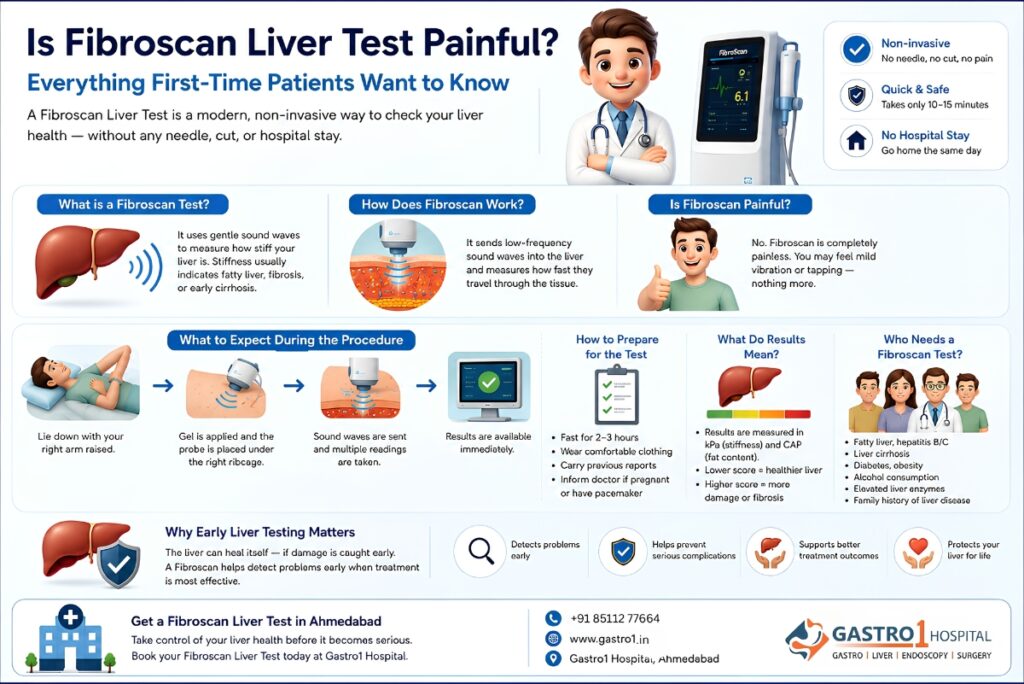
Is Fibroscan Liver Test Painful? Everything First-Time Patients Want to Know
What is a Fibroscan Liver Test?
Many people ignore liver health until something goes wrong. By then, the damage is often already done.
A Fibroscan Liver Test is a modern, non-invasive way to check your liver health — without any needle, cut, or hospital stay. It uses gentle sound waves to measure how stiff your liver is. Stiffness in the liver is usually a sign of fatty liver, fibrosis, or early cirrhosis.
Think of it as a health check for your liver — quick, safe, and completely painless.
How Does Fibroscan Work?
The technology behind Fibroscan is called Transient Elastography. It sends low-frequency sound waves into the liver and measures how fast they travel through the tissue.
Healthy liver tissue is soft — sound waves pass through easily. A damaged or scarred liver is stiffer — sound waves travel faster. This speed is converted into a score that tells your doctor the exact condition of your liver.
It works on a similar concept to an ultrasound but is specifically designed to assess liver stiffness and fat content — making it far more precise for liver conditions.
Is Fibroscan Liver Test Painful?
This is the most common concern patients have — and the answer is simple.
No. Fibroscan is completely painless.
During the test, a small probe is gently placed on your skin just below the right ribcage. You may feel a mild vibration or soft tapping — nothing more. Most patients are surprised by how easy and comfortable the experience is.
There are no injections, no incisions, and no sedation required. You are awake throughout and can go home immediately after.
What to Expect During the Procedure
The entire Fibroscan procedure takes around 10 to 15 minutes.
You lie down on the examination table with your right arm raised. A small amount of gel is applied to the skin, similar to an ultrasound. The probe is then gently placed on the skin surface and pressed lightly. It sends sound waves into the liver and records multiple readings to ensure accuracy.
Once done, results are available almost immediately – no waiting for days.
How to Prepare for a Fibroscan Test
Preparation is simple and minimal:
- Avoid eating or drinking for at least 2 to 3 hours before the test
- Wear loose, comfortable clothing so the right side of your abdomen is easily accessible
- Carry your previous liver reports, blood tests, or ultrasound scans if available
- Inform your doctor if you have a pacemaker or are pregnant
No special diet, no medication changes, and no recovery time needed after the test.
What Do Fibroscan Results Mean?
Fibroscan results are measured in kilopascals (kPa) for liver stiffness and CAP score for fat content.
A lower kPa score generally means a healthier liver with little to no fibrosis. As the score increases, it may indicate early fibrosis, advanced fibrosis, or cirrhosis. Your doctor will always interpret these results alongside your blood reports, symptoms, and medical history — a single number never tells the complete story.
Fibroscan vs Liver Biopsy — What is the Difference?
For years, liver biopsy was the only reliable way to assess liver damage. It involves inserting a needle into the liver to collect tissue, which carries risks like pain, bleeding, and infection.
Fibroscan has changed this significantly. It is non-invasive, painless, and gives results within minutes. While biopsy still has its place in certain complex cases, Fibroscan is now the preferred first-line assessment tool for most liver conditions, including hepatitis, liver cancer, and portal hypertension.
Who Needs a Fibroscan Liver Test?
Doctors usually recommend a Fibroscan for patients who have:
- Fatty liver disease (NAFLD or NASH)
- Hepatitis B or Hepatitis C infection
- Liver cirrhosis — to monitor progression
- Regular or heavy alcohol consumption
- Diabetes, obesity, or metabolic syndrome
- Elevated liver enzymes in blood reports
- A family history of liver disease
Liver disease is often called a silent condition — symptoms appear only when damage is already significant. A Fibroscan helps detect problems early, when treatment is most effective.
Why Early Liver Testing Matters
The liver is one of the few organs that can repair itself — but only if the damage is caught early enough.
Conditions like fatty liver and early fibrosis can often be managed or even reversed with the right medical guidance and lifestyle changes. Advanced cirrhosis, however, is much harder to treat.
Getting a Fibroscan Liver Test in Ahmedabad at the right time gives patients a real opportunity to take control of their liver health before it becomes serious. To know more or book a consultation, visit Gastro1 Hospital.